
What Funnels Measure vs What Actually Converts in an AI-Driven World
Table of Contents
What Funnels Measure vs What Actually Converts
Marketing funnels were designed to simplify growth. They break customer journeys into clean stages and rely on funnel metrics impressions, clicks, leads, and conversions to explain performance. For a long time, this made marketing feel measurable and predictable.
But real conversion behavior doesn’t follow dashboards.
People convert when uncertainty drops, not when they hit the bottom of a funnel. Trust, relevance, timing, and perceived value shape decisions far more than stage progression. Funnels capture visible actions, but they rarely explain why those actions happen.
In today’s AI-driven marketing environment, where users interact with brands through search engines, AI summaries, social platforms, and content recommendations, decisions are formed long before a tracked conversion occurs.
Funnels measure activity.
Conversion is driven by understanding.
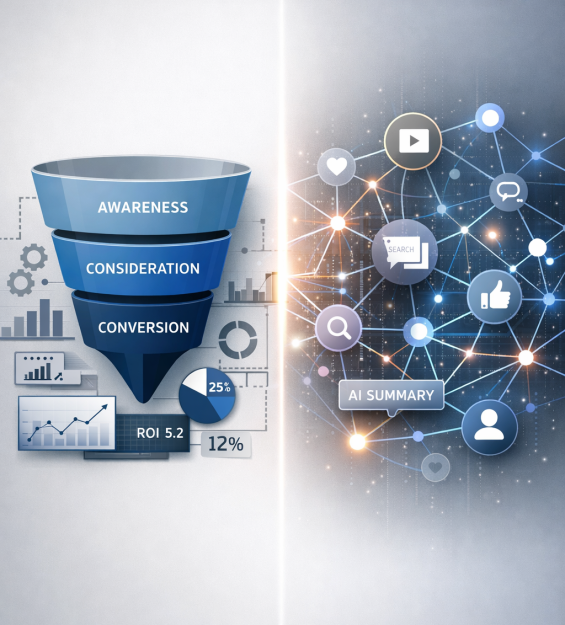
Why Funnels Look Perfect on Dashboards and Fail in Reality
Funnels perform well on dashboards because they compress complex human behavior into linear flows. Marketing analytics rewards clarity, not realism. When drop-off rates improve or conversions increase, it feels like optimization is working.
In reality, non-linear customer journeys dominate. Users move across platforms, pause for days or weeks, compare silently, and rely on signals outside a brand’s control. A single conversion may be influenced by dozens of untracked interactions.
This is where marketing analytics limitations become visible. Funnels assume consistency and predictability, while human decision-making is contextual and emotional.
The dashboard looks clean.
The journey is not.
The Hidden Trade-Off Funnels Never Talk About
Aggressively optimizing funnels often leads brands to prioritize efficiency over clarity. Content becomes transactional. Messaging is designed to push movement rather than build understanding.
This creates a critical trade-off. While funnel optimization may increase short-term conversions, it can weaken long-term outcomes like retention, brand trust, and loyalty. Users convert, but they don’t fully internalize the brand’s value.
Funnels are excellent at reducing friction.
They are poor at building conviction.
Over time, this gap shows up as higher churn and declining brand equity.
Why High-Converting Funnels Still Lose Customers
A high conversion rate is not the same as sustainable growth. Many high-converting funnels succeed by removing hesitation without resolving uncertainty.
When customers don’t fully understand what they’re choosing or why it matters, retention suffers. This is why brands with impressive conversion dashboards still struggle with churn, weak loyalty, and low advocacy.
Conversion metrics tell you that someone acted.
They don’t tell you how confident that decision was.
Retention is the real indicator of whether conversion behavior was meaningful.
How AI Is Reshaping Every Stage of the Funnel at Once
AI doesn’t operate in stages. It identifies patterns.
Modern AI marketing strategies analyze behavior across time, platforms, and content formats. Instead of isolating awareness, consideration, and conversion, AI connects signals that traditional funnels treat as separate.
This reshapes how funnels function. Rather than driving strategy, funnels become reporting layers. The real intelligence comes from AI-powered systems that understand intent, hesitation, and readiness dynamically.
The result is not faster funnels, but smarter decisions.
What Happens When AI Replaces Funnel Stages With Signals
When behavioral signals replace funnel stages, marketing becomes responsive instead of directive. Engagement depth, content sequencing, and return behavior become more valuable than isolated clicks.
Signals such as reading patterns, repeat exposure, and contextual engagement reveal far more about intent than stage-based models ever could. This enables AI-powered content strategy to adapt in real time.
In this model, conversion is not forced.
It emerges naturally from relevance.
Why AI Doesn’t Fit Inside Funnels
Funnels are built on control.
AI is built on adaptation.
Trying to force AI into predefined funnel stages limits its potential. AI-first marketing thrives when systems are allowed to learn freely from complexity, not when they’re constrained by linear frameworks.
Funnels assume predictability.
AI is designed for uncertainty.
That’s why modern brands are shifting from funnel-centric thinking to content ecosystems that evolve alongside audience behavior.
What This Means for Modern Brands (MediaX Perspective)
For modern brands, funnels should measure outcomes not dictate strategy. Growth today depends on how well a brand understands intent, not how efficiently it pushes users through stages.
At MediaX, we focus on building AI-driven content ecosystems where value compounds across touchpoints. Content is designed to educate, clarify, and reinforce trust across platforms, formats, and moments.
Our AI-powered media approach identifies what content builds confidence, where understanding breaks down, and how signals evolve over time. Funnels then reflect the result of that intelligence rather than controlling it.
This shifts marketing from pressure to precision.
Conclusion: The Shift Brands Must Make
Funnels will continue to measure movement.
But movement is not meaningful.
In an AI-driven world, real growth comes from understanding how decisions form, not from forcing progression through stages. Brands that adapt will stop chasing conversions and start earning trust.
The future of marketing isn’t better funnels.
It’s better intelligence, better content, and better understanding.
FAQs
1. What do marketing funnels actually measure?
Marketing funnels primarily measure visible actions such as impressions, clicks, sign-ups, and purchases. These funnel metrics show movement through stages, but they do not fully capture the underlying conversion behavior such as trust, understanding, or confidence that drives real decisions.
2. Why do funnels fail to reflect real customer behavior?
Funnels assume that customer journeys are linear and predictable. In reality, modern users follow non-linear customer journeys, interacting with content across platforms, devices, and timeframes. Decisions are influenced by repeated exposure, external validation, and context factors that traditional funnels often miss.
3. How does AI change the way conversions happen?
AI changes conversion by shifting focus from stages to behavioral signals. Instead of pushing users through predefined steps, AI-driven marketing analyzes patterns such as engagement depth, content sequencing, and intent signals to understand when users are ready to act.
4. Why do high-converting funnels still struggle with retention?
High-converting funnels often optimize for speed rather than clarity. When users convert without fully understanding the value proposition, confidence is weak. This leads to churn, even when conversion rates look strong. Retention depends on conviction, not just friction removal.
5. What are content ecosystems, and why are they replacing funnels?
Content ecosystems are interconnected networks of content, signals, and touchpoints that evolve with user behavior. Unlike funnels, they support learning, trust-building, and relevance over time. AI enables these ecosystems by identifying what content contributes to real understanding and long-term conversion.
6. How should modern brands use funnels alongside AI?
Funnels should be used as measurement tools, not strategic constraints. Modern brands combine funnels with AI-powered content strategy to understand intent, adapt messaging, and support decision-making across multiple touchpoints. This allows funnels to reflect outcomes rather than dictate user paths.