
SEO, AEO and GEO: How to Get Found, Chosen and Recommended in AI Search
Table of Contents
Digital discovery has entered a new era. Users are no longer scrolling through pages of links or opening multiple tabs to compare information. Search today is shaped by AI-generated summaries, conversational responses, voice assistants, visual cues, and instant comparisons. This evolution has fundamentally changed how visibility works online.
Traditional SEO alone is no longer enough. Rankings still play a role, but modern visibility depends on whether a brand is found, selected, and repeatedly recommended by AI systems. This is where SEO, AEO, and GEO come together. As a unified strategy, they determine how brands earn attention, trust, and authority in an AI-first search landscape.
Why Digital Visibility Has Changed
User behavior has shifted towards speed, clarity, and confidence. People want answers, not options. Instead of browsing multiple sources, they expect AI to summarize information, validate it, and guide decisions instantly.
As a result, zero-click interactions have become normal, AI summaries now influence buying decisions, and visibility often happens inside search results rather than on websites themselves. Authority is no longer built through rankings alone but through repeated exposure and trusted recommendations. Search has moved from simple retrieval to intelligent recommendation, and visibility has shifted from position to presence.
SEO: Be Found
SEO remains the foundation of digital visibility. Without it, no other optimization layer can function. Search engines still need to crawl, index, and understand your content before AI systems can evaluate or recommend it.
Modern SEO focuses on more than keywords. It emphasizes topical authority, semantic clarity, internal linking, site structure, and user experience. SEO ensures your brand enters the discovery layer and becomes eligible for visibility. However, discovery alone does not guarantee trust. SEO helps your brand exist in search, but it does not ensure it will be chosen.
AEO: Be the Answer
Search today is driven by questions. Users speak into devices, rely on Google’s Search Generative Experience, and expect direct, accurate responses. They are no longer looking for lists of pages but for immediate solutions.
Answer Engine Optimization restructures content so AI systems can clearly identify the best response, understand context, and extract concise, validated information. This requires well-defined headings, conversational formatting, clear explanations, FAQs, and credible authorship. When AEO is implemented correctly, your brand earns visibility before the click even happens. It becomes the source the AI trusts enough to quote directly.
SEO helps you get seen. AEO helps you get selected.
GEO: Be Recommended
Generative AI goes beyond answering questions. It summarizes, compares, ranks, and recommends. Generative Engine Optimization focuses on shaping how your brand appears across multi-turn AI conversations.
GEO ensures your brand is referenced repeatedly as users ask follow-up questions, compare options, and seek deeper clarity. It builds memorability through consistency, expert voice, verified data, and thematic depth. When AI repeatedly cites a brand, it becomes trusted not because of rankings, but because it has proven reliable over time.
If SEO gets you found and AEO gets you chosen, GEO makes you unforgettable.
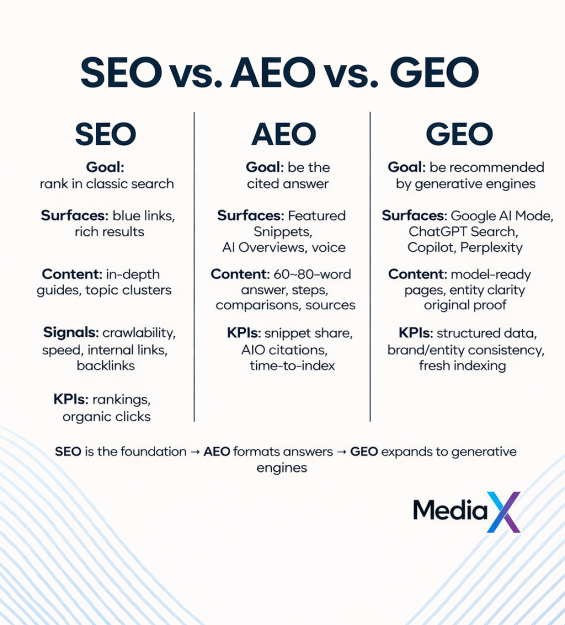
SEO vs AEO vs GEO: How They Work Together
SEO focuses on discoverability and indexing. AEO focuses on clarity and answer selection. GEO focuses on recommendation frequency and conversational presence. These are not competing strategies. They are layers that build on one another.
SEO helps search engines understand your content. AEO helps AI present it as the best answer. GEO ensures your brand is remembered and reinforced across ongoing interactions. Together, they form a complete visibility framework for AI-driven search.
Real-World Visibility in Practice
A brand with strong SEO appears in search results. A brand with effective AEO is quoted inside AI summaries and voice responses. A brand optimized for GEO is mentioned multiple times as users continue the conversation and explore related questions.
The most successful brands operate across all three layers. They are discovered early, trusted quickly, and remembered consistently.
How to Implement SEO, AEO and GEO
Implementation begins with strong SEO fundamentals, including clean site architecture, crawlable internal linking, clear entity signals, and structured on-page content. Once this foundation is in place, AEO strengthens content by introducing question-based headings, concise answers, factual support, and visible expertise.
GEO is built through consistency. Publishing expert-led content across related topics, maintaining a clear brand voice, and addressing follow-up questions naturally helps AI systems recognize long-term authority. The goal is not ranking for a single keyword but becoming recommendation-ready across conversations.
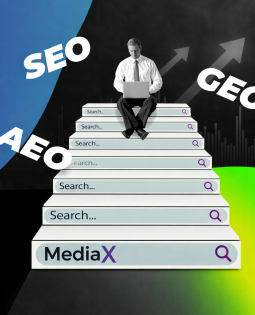
Why This Trio Matters More Than Rankings
Success in modern search is no longer measured only by traffic. Users value time saved, confusion reduced, and confidence gained. Zero-click interactions are now standard, and visibility is increasingly defined by presence inside AI summaries rather than blue-link positions.
Visibility has shifted from page rankings to recommendation frequency, from clicks to brand recall, and from keywords to authority. Brands that win are those that explain clearly, answer faster, and remove friction from decision-making.
Conclusion : The Future of Digital Visibility
The future of search is not about claiming the top spot on a results page. It is about becoming the source an AI system trusts enough to present, repeat, and reinforce.
That level of trust requires expertise, structure, transparency, and genuine value. SEO gets a brand discovered. AEO earns credibility. GEO establishes preference. Together, SEO, AEO, and GEO define the new competitive formula for digital growth in an AI-first world.
FAQs
1. What is the difference between SEO, AEO, and GEO?
SEO focuses on helping content get discovered through search engine indexing and rankings. AEO optimizes content so AI systems can identify and present it as the best direct answer. GEO ensures a brand is repeatedly recommended and referenced across AI-driven conversations. Together, they move visibility from rankings to recommendations.
2. Why is traditional SEO no longer enough in AI search?
Traditional SEO helps content appear in search results, but AI search prioritizes answers, summaries, and recommendations. Without AEO and GEO, content may rank but never be selected or cited by AI systems. Modern visibility depends on being understood, trusted, and recommended by AI, not just indexed.
3. How does AEO help content appear in AI summaries?
AEO structures content in a way AI systems can easily extract and validate. Clear headings, concise answers, FAQs, conversational formatting, and credible sources help AI identify the most accurate response and present it directly in AI summaries, voice search, and zero-click results.
4. What does it mean to be “recommended” by AI search engines?
Being recommended means an AI system repeatedly references your brand as users ask follow-up questions, compare options, or seek deeper information. This happens when content demonstrates consistent expertise, reliable data, and topical depth—key principles of Generative Engine Optimization (GEO).
5. How can brands implement SEO, AEO, and GEO together?
Brands should start with strong SEO fundamentals to ensure discoverability, then apply AEO by optimizing content for clear, direct answers. GEO is built by publishing consistent, expert-led content across related topics so AI systems recognize long-term authority and recommendation-worthiness.