
What Happens to SEO When AI Answers Replace Clicks And What Every Brand Must Do Before It’s Too Late
60%+ of all Google searches end with zero clicks | 93% of Google AI Mode queries never leave the SERP | 58% CTR drop when an AI Overview appears above results | 14% of marketers currently track AI search visibility |
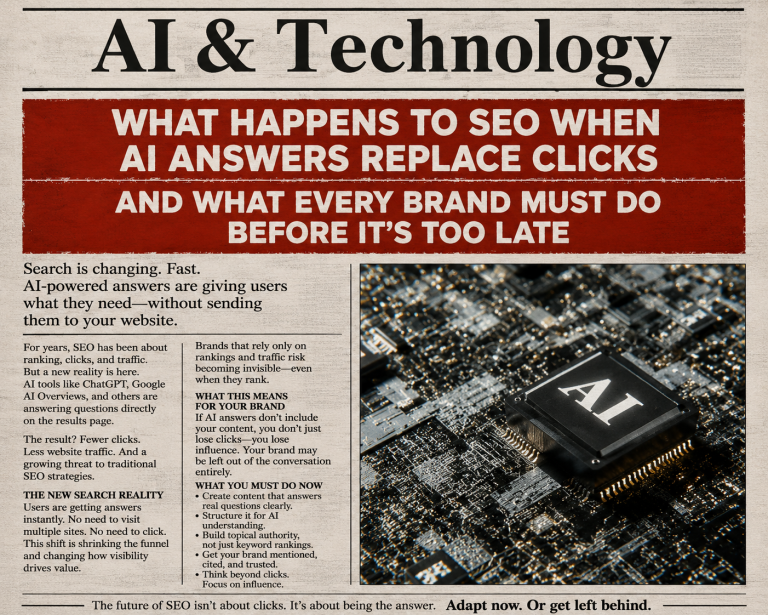
The Search Engine You Built Your Business on Has Changed
Something happened to your organic traffic and you may not have noticed yet or worse, you have noticed and you don’t know why.
Your content still ranks on page one. Your keyword positions haven’t moved. But sessions are down 20%, 30%, maybe more. The content is doing its job. The problem is that Google is now doing your job for you answering your visitors’ questions before they ever reach your site.
This is not a temporary algorithm update. It is a structural, permanent shift in how search engines work. And it has profound consequences for every brand, agency, and business that depends on organic search for visibility, leads, and revenue.
In this guide written from the frontlines of AI search optimisation we break down exactly what is happening, why it matters for your brand, and the concrete strategy every business needs to adopt right now.
If your SEO strategy was built before 2024, it was built for a search engine that no longer fully exists. This is what replaces it.
What Is Actually Happening on Google Right Now
The zero-click takeover
Let’s start with the numbers, because they are staggering.
According to data from SparkToro, Similarweb, and multiple independent studies published in early 2026:
Over 60% of all Google searches in 2026 end without a single click to any external website
For queries handled by Google’s AI Mode, that figure rises to 93% meaning 9 out of every 10 AI Mode searches never produce a visit to your site
AI Overviews now appear in 58% of all queries up from just 12% in 2024
When an AI Overview is present, click-through rates for position one drop by up to 58% compared to traditional results
Only 1% of searches result in a user clicking a link within an AI Overview
To put it simply: Google has become the destination, not the gateway.
The rise of zero-click searches represents the most profound shift in search behaviour since Google introduced featured snippets. The brands winning in 2026 are those who adapted their strategy to match the new reality not those still chasing position one as if it were 2020
How did we get here?
The zero-click trend did not begin with AI. SparkToro’s Rand Fishkin first documented it in 2019, when roughly 50% of searches already ended on the results page. What changed between 2024 and 2026 is the acceleration rate.
Google’s AI Overviews rolled out globally in late 2024 and expanded aggressively through 2025 pushed the zero-click share from 55% to over 60% in roughly 18 months. That is the largest single-year increase in the history of this metric.
The mechanism is straightforward. When Google’s AI synthesises a complete answer to your query a definition, a list of steps, a comparison, a recommendation there is no remaining intent that requires visiting a website. The user got what they came for. Google calls this ‘organising the world’s information.’ Publishers call it something less polite.
What This Means for Your SEO The Honest Breakdown
The metric you’ve been measuring is now misleading you
If your primary SEO success metric is organic sessions or click-through rate, you are now measuring the wrong thing. In a zero-click world, a brand can appear prominently in search results cited in AI Overviews, featured in knowledge panels, quoted in People Also Ask boxes and generate significant brand awareness, trust, and downstream revenue without receiving a single referral click from that exposure.
This is not a failure of SEO. It is a failure of measurement.
Consider this scenario: a user searches ‘best AI creative agency in India’, sees MediaX cited in Google’s AI Overview, does not click but three days later searches ‘MediaX agency Bengaluru’ and books a consultation. Traditional analytics attributes that conversion to direct or branded search. The AI Overview that drove the decision is invisible in your dashboard.
A 30% drop in organic sessions combined with a 15% increase in organic conversions is not an SEO failure. It is an SEO improvement in a zero-click environment. The clicks that survive are higher-intent, better-converting visitors who already trust your brand from SERP exposure.
The New Game From Rankings to Citations
What Generative Engine Optimisation (GEO) actually means
The SEO industry has a new acronym: GEO Generative Engine Optimisation. It refers to the practice of optimising your content so that AI-powered answer engines Google AI Overviews, ChatGPT Search, Perplexity, Gemini cite, reference, or summarise your brand in their generated responses.
Unlike traditional SEO, which targets a position in a ranked list of blue links, GEO targets inclusion in AI-generated answers. A brand cited in an AI Overview may receive no direct click but gains:
Brand impressions with a highly relevant, actively searching audience
Authority signals Google’s choice to cite you implies trust and expertise
Downstream branded search users who see your brand in an AI answer often search your name later
Competitive positioning being cited while a competitor is not is a significant advantage
According to a 2026 Goodfirms survey of over 100 digital marketing practitioners, 43% of marketers are now actively implementing GEO strategies up from near zero in 2025. Only 14% are currently tracking their AI search visibility. The gap between awareness and action is enormous, and that gap is your opportunity.
How Google’s AI actually decides what to quote
This is the question every content strategist needs to understand deeply. Google’s AI Overviews do not randomly select sources. The selection process prioritises:
E-E-A-T signals Experience, Expertise, Authoritativeness, Trustworthiness, evaluated not through on-page claims but through off-site validation: third-party publications that mention you, authoritative sites that link to you, and the broader web consensus about your credibility.
Structured, extractable content AI systems favour content with clear 40–60 word answer blocks in the first 100 words, comparison tables with three or more columns, FAQ sections with schema markup, and bullet-pointed lists. Research by AirOps (April 2026) found that comparison pages with three or more tables earn 25.7% more AI citations.
Freshness and recency AI engines, particularly those handling current-events queries, strongly favour content published or substantially updated within the last 90 days.
Semantic comprehensiveness content that covers a topic’s full breadth (not just one angle) signals topical authority to AI systems. Google’s AI is not matching keywords it is identifying the most complete, trustworthy source for a given concept.
Brand entity strength brands with properly implemented Organisation schema, consistent NAP data, strong Google Business Profiles, and mentions across authoritative publications are cited more frequently.
The key insight: Google's AI is not picking the highest-ranking page. It is picking the most trustworthy, most clearly structured, most comprehensively authoritative source. Those are different things and the gap between them is where most brands are losing.
The 7- Point Strategy for SEO in the AI Answer Era
Here is what an effective SEO strategy looks like in 2026. This is not a complete replacement of what worked before it is a significant rebalancing of priorities.
1. Lead every piece of content with an answer block
Place a complete, standalone 40–60 word answer to your target question in the first 100 words of every informational article. Write it to be extractable clear subject, verb, object, no jargon, no hedging. This is the single highest-impact structural change you can make to existing content.
Example: For a post titled ‘What is AI creative agency?’, the first paragraph should completely answer that question in two to three clear sentences before expanding into detail.
2. Restructure your content around questions, not keywords
AI systems process intent, not keywords. Every H2 and H3 in your content should mirror the exact phrasing of a real user question the kind that appears in People Also Ask boxes, Reddit threads, and Quora. Use AnswerThePublic, Google Search Console’s query data, and PAA boxes to identify these questions for your specific niche.
3. Invest in structured data as infrastructure, not as an add-on
FAQ schema, How To schema, Article schema, Organisation schema, and Breadcrumb List schema are no longer optional for brands that want AI citation. Implement all relevant schema types across every page on your site. Validate monthly using Google’s Rich Results Test. Treat schema markup the way you treat site speed as critical technical infrastructure.
4. Shift your KPIs before your team loses faith in SEO
Update your measurement framework now, before the conversation with leadership becomes a crisis. Track:
AI Overview citation frequency how often your domain appears in AI-generated answers for target queries
Branded search volume a reliable proxy for AI-assisted awareness that preceded a click
Organic conversion rate quality of clicks in a zero-click environment typically improves as casual browsers filter out
Share of voice in AI answers your citation shares relative to competitors across your core topic cluster
5. Build topical authority through content clusters, not individual posts
A single well-written article rarely earns AI citations. A comprehensive topic cluster a pillar page supported by ten to fifteen cluster articles, all internally linked, all covering a topic from multiple angles signals the kind of deep topical authority that AI engines consistently prefer as citation sources.
For a brand like MediaX, this means building complete clusters around AI creative production, video marketing strategy, UI/UX design best practices, and SEO for Indian brands not publishing one-off posts on disconnected topics.
6. Invest in digital PR for off-site brand validation
E-E-A-T is evaluated off-site. Getting your brand cited in Economic Times, YourStory, Entrackr, or industry-specific publications does more for your AI citation eligibility than any on-page optimisation. A structured digital PR programme contributing expert quotes, publishing original research, and securing third-party feature coverage is now a core SEO activity, not a marketing bonus.
7. Do not abandon informational content repurpose it for AI
The instinct many brands have to stop producing informational content because it no longer drives clicks is strategically wrong. Informational content is precisely what gets cited in AI Overviews. The goal is not to use it to generate clicks directly, but to use it to earn AI citations that build brand awareness, trust, and downstream branded search among users who will eventually need your services.
Think of informational content in 2026 the way you think of a billboard. It generates awareness at the moment of need. The conversion happens later, on the user's terms. The brands that stop publishing informational content will disappear from AI answers entirely and with them, from the consideration set of their future customers
What This Means Specifically for Indian Brands
The zero-click revolution is not a Western phenomenon. Indian search behaviour is moving in the same direction accelerated by the rapid adoption of AI tools among India’s educated urban demographic, the same audience that most B2B and premium D2C brands are targeting.
A few India-specific dimensions that make this conversation more urgent:
B2B technology queries in India saw AI Overview coverage grow from 36% to 82% between 2025 and 2026 the steepest increase of any industry category globally
Mobile-first search behaviour makes zero-click even more prevalent mobile users are 66% more likely to experience a zero-click search than desktop users, and India is overwhelmingly a mobile-first market
Indian brands are significantly behind in GEO adoption the gap between global and Indian brand AI citation rates is substantial, which means early movers gain disproportionate advantage
Regional language queries are expanding into AI Overviews Hindi, Tamil, Telugu, and Kannada language search is now increasingly served by AI-generated answers, opening new citation opportunities for brands with multilingual content strategies
For Indian agencies, EdTech companies, D2C brands, and professional service firms, the window to establish AI search authority before the market becomes crowded is open right now but it is closing fast.
The Bottom Line
SEO is not dead. It has been promoted to a more complex, higher-stakes discipline.
The brands that win in the AI search era are not the ones with the highest rankings. They are the ones that AI engines trust enough to quote brands with deep topical authority, structured content, off-site validation, and the strategic clarity to measure visibility rather than just clicks.
The question is not whether this shift will affect your business. It already has. The question is whether you will adapt proactively or reactively.
MediaX helps Indian brands build SEO and content strategies designed for the AI search era. From topical authority planning and structured content production to digital PR and GEO implementation we run the full pipeline. Talk to our team at themediax.ai/contact-us-1 to start.
Frequently Asked Questions
1. What is a zero-click search?
A zero-click search occurs when a user’s query is answered directly within Google’s results page through AI Overviews, featured snippets, knowledge panels, or direct answer boxes without the user clicking through to any external website.
2. How many searches now end without a click in 2026?
Multiple studies from early 2026 confirm that over 60% of all Google searches end without a click. For queries handled by Google’s AI Mode specifically, that figure rises to 93%.
3. Is SEO still worth investing in if AI answers replace clicks?
Yes, but the strategy must change. The goal shifts from generating clicks to earning citations in AI-generated answers, building brand authority that drives downstream branded search, and producing transactional content that still generates high-intent clicks. Brands that abandon SEO will disappear from AI answers entirely.
4. What is GEO and how is it different from SEO?
GEO Generative Engine Optimisation is the practice of optimising content to be cited, referenced, or summarised by AI-powered answer engines. Traditional SEO targets a position in a ranked list of links. GEO targets inclusion in AI-generated answers, which may generate brand awareness and trust without producing a direct click.
5. How do I know if my brand is being cited in Google’s AI Overviews?
Use Google Search Console to monitor which queries display AI Overviews for your tracked keywords. Semrush’s AI Visibility Toolkit provides citation tracking across AI platforms. Regularly run target queries manually and note whether your domain is cited as a source.
6. What types of content are most likely to be cited by AI?
Content with clear 40–60 word answer blocks, comparison tables, FAQ sections with schema markup, and comprehensive topic coverage consistently earns higher AI citation rates. Research from AirOps (April 2026) found comparison pages with three or more tables earn 25.7% more AI citations than equivalent content without tables.